The ARRT Radiography Boards is structured to test whether you can practice safely and competently as a registered technologist. It is not designed to fail you. It is designed to find the technologists who reliably know the right answer at the right time, especially when the right answer prevents harm.
The first-time pass rate hovers around 85% nationally. That sounds high, but it means roughly one in seven candidates does not pass on the first attempt. The patterns that separate the passers from the not-yet-passers are surprisingly consistent.
This is the plan that works.
The 2025 ARRT Content Specifications, in one paragraph
The exam has 200 scored questions plus 20 unscored pilot questions, delivered over 3.5 hours in a computer-based testing environment. Questions split across 8 scoring categories. The big four by weight: Patient Interactions and Management at 23%, Image Acquisition and Evaluation at 22%, Equipment Operation and QA at 12%, Radiation Physics and Radiobiology at 10%. The procedural categories together account for roughly 30%: Extremity (~11%), Thorax and Abdomen (~8%), and Head, Spine, and Pelvis (~7%). Radiation Protection rounds out the safety domain at ~10%.
This is the blueprint. Everything you study should map back to one of those categories, in proportion to its exam weight.
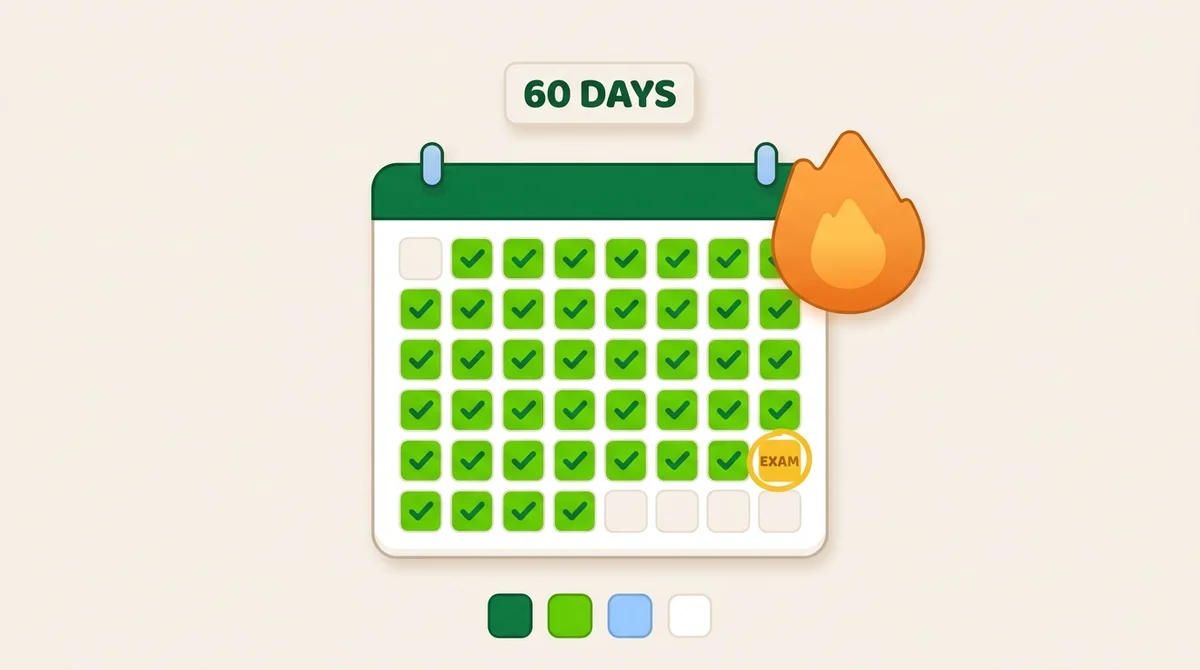
The 60-day study plan that actually works
The single biggest predictor of first-time success is consistency over intensity. Two hours a day for 60 days outperforms eight hours a day for 15 days, even though the total time is identical. Your brain consolidates memories during sleep, cramming truncates that consolidation.
Here is a 60-day plan that has produced first-attempt passes in our beta cohort:
Days 1–7: The blueprint week. Read the 2025 ARRT Content Specifications in full. Mark the categories you feel weakest in. Take a baseline diagnostic, whatever the prep tool offers. The baseline tells you where to invest your first month.
Days 8–28: Domain-by-domain content learning. Work through one ARRT domain per week: Patient Care, then Image Production, then Procedures, then Safety. For each domain, read the chapter overview, watch or read the lessons, complete the knowledge checks, and drill 50–80 practice questions in that domain.
Days 29–45: The drill phase. Stop reading. Drill questions. 100 questions a day, mixed across all 8 categories. Pause on every miss and re-read the rationale. Tag the question with the chapter it came from. After every 100-question drill, review the chapters where you missed three or more questions.
Days 46–55: Mock exams. Take the first 200-question timed mock. Score it honestly. Review every wrong answer (and every right-but-guessed answer). Do the second mock four days later. Do the third mock at day 55. By this point your scores should be 75% or higher.
Days 56–60: The taper. Light review, no new content. Reinforce the highest-yield facts: dose limits, the 15% rule, the four conditions of consent, the four elements of negligence, basic life support sequence, the workhorse skull projections (Caldwell, Towne, Waters, SMV). Sleep eight hours a night.
What to study (and what to skip)
Most students over-study and under-drill. The ARRT exam is a recognition test more than a recall test. You don’t have to derive bremsstrahlung from first principles. You have to recognize it in a question stem.
Study deeply:
- Patient identification and the four conditions of valid consent
- Negligence: duty, breach, injury, cause
- ARRT Rules 21 and 22 (duty to report)
- Standard Precautions and the three transmission categories (Contact, Droplet, Airborne)
- Iodinated contrast reactions: mild, moderate, severe
- Oxygen delivery devices (cannula, simple mask, non-rebreather, Venturi)
- The 15% rule (kVp/mAs density relationship)
- Inverse square law and density maintenance
- Grid Bucky factors (5:1 = 2×, 8:1 = 4×, 12:1 = 5×, 16:1 = 6×)
- Workhorse skull projections (Caldwell, Towne, Waters, SMV) and their baselines
- The four cranial baselines (OML, IOML, GAL)
- Open-mouth odontoid for C1/C2/dens
- The Scotty Dog (lumbar oblique and spondylolysis)
- PA chest standards (72 inch SID, 10 posterior ribs above diaphragm)
- Photon interactions: photoelectric (contrast), Compton (operator dose)
- Occupational dose limit (5 rem/year whole body) and pregnant radiographer limit (0.5 rem total)
Don’t waste time on:
- Memorizing every named projection variant. Knowing the workhorses (above) gets you 85%+ on procedures questions.
- Deep historical knowledge of the ARRT itself.
- Highly mathematical derivations beyond what a calculator handles in 60 seconds.
- Rare contrast media or obsolete equipment (CR systems still tested; xeroradiography is not).
Five mistakes that cause first-attempt failures
1. Only studying with one resource. Lange Q&A is an excellent reference book. So is Mosby. So are Anki decks. So are subscription apps. Use at least two formats, they expose different weaknesses.
2. Skipping the rationales. Right answers don’t teach you anything. Every wrong answer explanation should make you go “oh, I see why now.” If it doesn’t, the question is doing you a favor, read it twice and re-drill the same topic tomorrow.
3. Cramming the last week. Consolidation requires sleep. Cramming the night before the exam reduces your score by an average of 5% in the cohort data we have access to.
4. Underestimating Patient Care. It’s the single biggest scoring category at 23% and many students treat it as the “soft” content. Every question you miss in Patient Care is two questions you have to make up elsewhere.
5. Not taking timed mock exams. A timed 200-question exam is mentally exhausting in a way that a 50-question drill is not. If your first timed mock is also test day, you’re discovering that exhaustion at the worst possible moment.
After the exam
You’ll get an unofficial pass/fail result on screen at the testing center. Official results take 7–14 business days. Pass and you’re a registered technologist with portable credentials. Fail and you have a 90-day waiting period before you can retest, with up to three attempts in three years.
If you don’t pass: it is not the end of your career. The retake pass rate is around 65%. Get the score breakdown the ARRT provides, identify the categories where you scored below 50%, and re-drill those specifically. Most second-attempt passers say the second time was easier because they knew the format.
What to do today
Open the 28-chapter curriculum and pick one chapter to read. Take five practice questions in the Patient Interactions category. Set a 60-day study calendar in your phone with the milestones above. Tell one person your goal, accountability is real.
The ARRT Boards is a hard, fair exam. It rewards consistency and clear methodology. If you give it 60 days of structured study, you will most likely pass on your first attempt, and you’ll feel more like a competent technologist on day one of your career than the 30% of your peers who studied less systematically.
You’ve got this.