ARRT subcategory · 14% of scored exam
Extremity Procedures
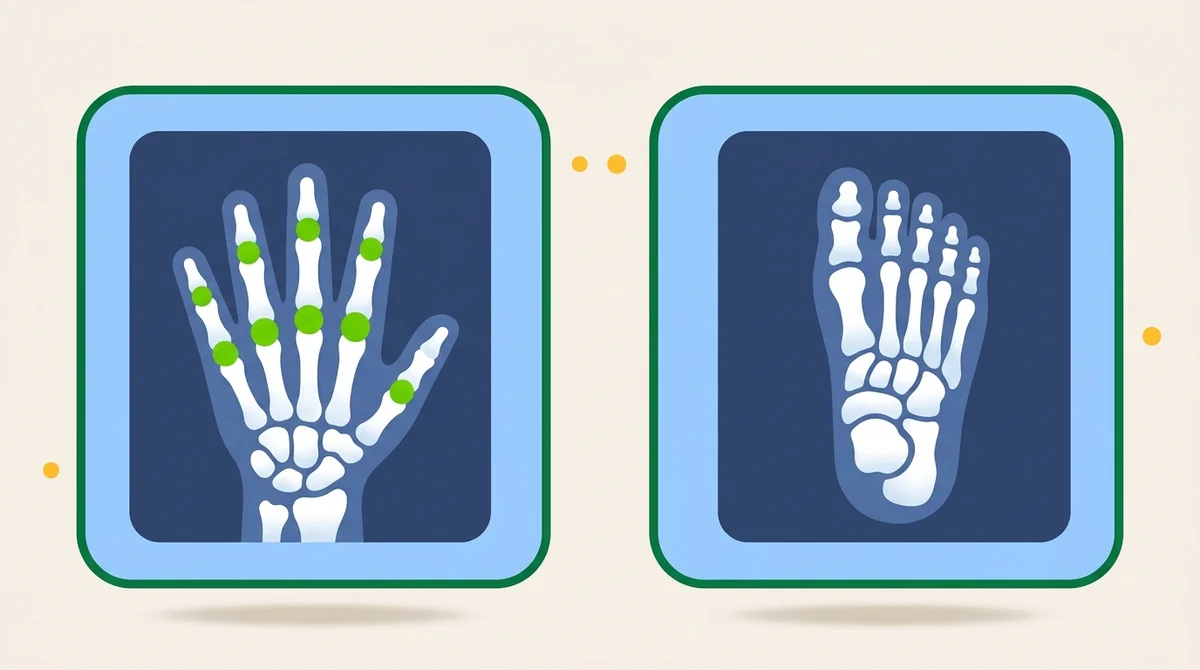
Covers positioning and projections for the fingers, hand, wrist, forearm, elbow, humerus, shoulder, scapula, AC joints, toes, foot, calcaneus, ankle, tibia and fibula, knee, patella, and femur, plus long bone measurement, bone age, bone survey and arthrography. ARRT lists the clavicle here in the 2022 outline and under Thorax in the 2027 outline, from 1 March 2027. It files the hip under Head, Spine and Pelvis in both.
28 of 200 scored questions under the 2022 content specification, in force through 28 February 2027. From 1 March 2027, the 2027 content specification lists 30 of 200.
Sample question
A free sample question, written for this page, like those in the 377-question Extremity bank. Read it, pick your answer, then expand the rationale.
A patient presents with wrist pain after falling on an outstretched hand. The PA, lateral, and oblique wrist projections appear normal but clinical suspicion for scaphoid fracture remains. What additional projection should be performed?
Show answer and full rationale
Correct answer: B. Stecher method
A, Incorrect: The carpal tunnel projection demonstrates the carpal tunnel itself.
B, Correct: Correct. ARRT and Merrill's call the Stecher method a PA axial scaphoid projection, while Bontrager titles its modified version a PA scaphoid. Both books raise the hand end 20° with a perpendicular CR, and Bontrager adds ulnar deviation. Merrill's also gives a variation with the CR 20° toward the elbow, and Bontrager gives a separate ulnar-deviation method with the CR angled 10° to 15° proximally. Use your program's text. Bontrager notes nondisplaced fractures may still need more projections or CT.
C, Incorrect: This is a real wrist projection, but it shows the medial carpals, not the scaphoid.
D, Incorrect: This is not a scaphoid projection. Radial deviation is its own PA wrist projection, and it shows the medial carpals.
Topics to study in this subcategory
Our study list, in common study terms where those differ from ARRT's. ARRT's content outline is the official list.
- Hand series (PA, PA oblique, lateral)
- Wrist series and the Stecher (scaphoid)
- Elbow series and trauma protocols
- Shoulder routines (AP int/ext rotation, Grashey, scapular Y)
- Foot, ankle, mortise projections
- Knee series, Holmblad, Camp-Coventry, Settegast
- Toes, calcaneus, tibia and fibula, and femur
- Common fractures (Colles, Boxer's, Jones, Pott)
- Pediatric extremity considerations
Drill the full 377-question bank.
The free tier includes a 50-question quiz and a 200-question sample exam, 241 different questions in all. A paid plan unlocks all 2,584 ARRT-style questions, unlimited generated mock exams, and drills in this subcategory that adapt question order to you. Paid plans open soon.
Frequently asked questions
How many Extremity questions are on the ARRT Radiography Boards?
The Extremity Procedures subcategory is 28 of the 200 scored questions under the 2022 content specification, in force through 28 February 2027, about 14% of the scored exam. From 1 March 2027, the 2027 content specification lists 30 of 200. The full Radtechprepper practice bank contains 377 questions in this category, giving you ample room to drill until the patterns are second nature.
What topics are in the Extremity subcategory?
Our study list for Extremity starts with: Hand series (PA, PA oblique, lateral); Wrist series and the Stecher (scaphoid); Elbow series and trauma protocols; Shoulder routines (AP int/ext rotation, Grashey, scapular Y); Foot, ankle, mortise projections. The official list is the content outline in ARRT Radiography Content Specifications. Our list uses common study terms in places, and the outline is what ARRT publishes.
How should I study for the Extremity subcategory?
Start with the chapter overviews listed on this page, which cover the core concepts in plain English. Then drill questions, pause on every miss, read the rationale, and re-drill the same topic the next day. Space your review over several days instead of cramming.